What Happens When the Appraisal Comes in Low in New Jersey?
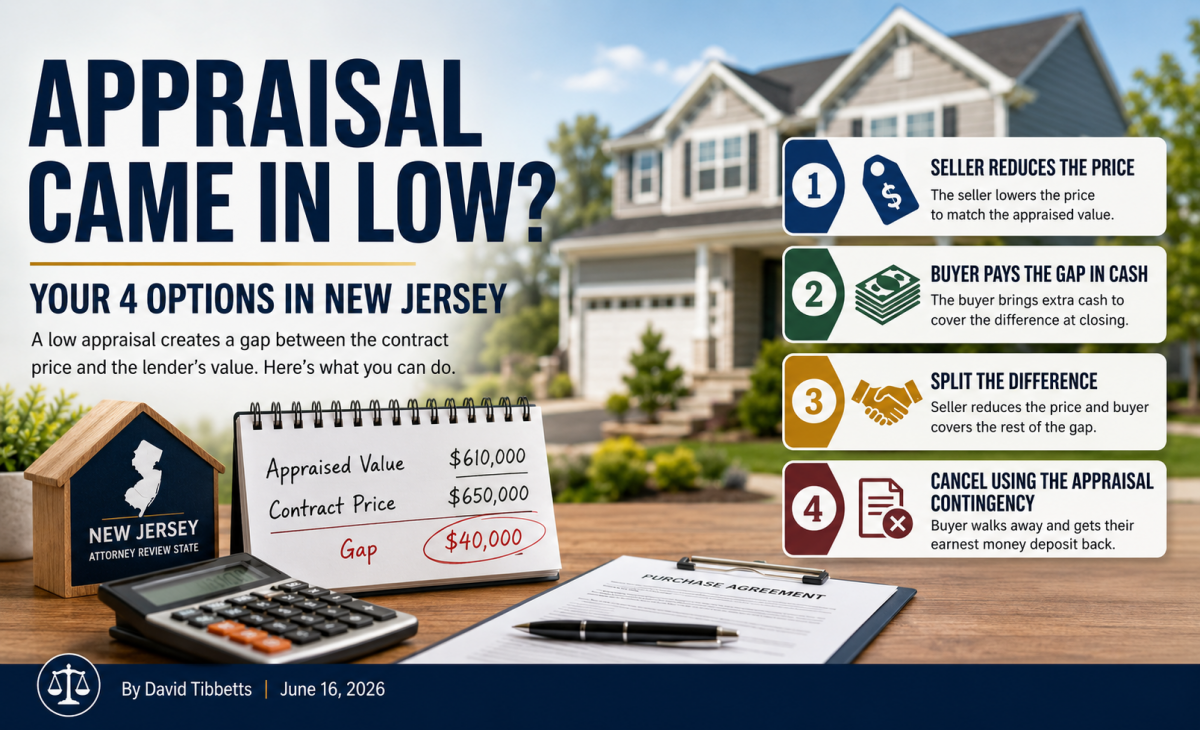
When an appraisal comes in below the purchase price in New Jersey, buyers and sellers have four options: the seller reduces the price to the appraised value, the buyer pays the difference in cash, both parties split the gap, or the buyer cancels using the appraisal contingency. Because New Jersey is an attorney review state, your real estate attorney plays a central role in working toward a resolution. The outcome depends on market conditions, each party’s motivation, and how the original contract was written.
By David Tibbetts | June 16, 2026
The call no one wants to get during a transaction is the one where your agent says, “The appraisal came back low.”
Whether you’re the buyer or the seller, it stops you cold. The deal you’ve both worked toward suddenly has a gap between what was agreed on and what the lender is willing to finance. And in New Jersey, where the attorney review period and specific contractual protections shape how deals get resolved, knowing your options before that call happens makes a real difference.
Here’s exactly what happens, and what you can do about it.
Why Low Appraisals Happen
An appraisal is an independent opinion of value ordered by the lender and completed by a licensed appraiser. It isn’t the Zillow estimate. It isn’t what a buyer believes the home is worth. It’s the appraiser’s analysis of what the property would sell for on the open market, based on comparable sales in the area.
In a competitive market like central New Jersey — particularly in Middlesex and Somerset counties, where inventory has stayed tight and homes regularly attract multiple offers — buyers sometimes bid above asking price to win. The problem: if recent sold comps don’t support that number, the appraisal lands below the agreed-upon sale price.
On a $650,000 home that appraises at $610,000, you’ve got a $40,000 gap. The lender won’t finance more than the appraised value. So now what?
One thing worth knowing: recent renovations can actually help support a higher appraised value. Updated kitchens, new roofs, and finished basements often show up positively in the appraiser’s analysis. More on that in the post on weekend projects that boost your property value.
Your Four Options
When the appraisal comes in below the purchase price, there are four paths forward. None of them are instant, and all of them involve some negotiation.
1. The seller reduces the price
The most common resolution in a buyer-friendly market is for the seller to lower the sale price to match the appraised value. On that $650,000 home appraising at $610,000, the seller accepts $610,000 and the deal closes.
Sellers don’t love this option, but consider the alternative. If they cancel and relist, they’ll be doing so in a market where the same appraisal issue could surface again. And the relisting itself signals to future buyers that something went sideways the first time.
2. The buyer pays the gap in cash
Some buyers cover the difference themselves, especially those who waived the appraisal contingency to compete in a multiple-offer situation. On that same $650K/$610K gap, the buyer brings an extra $40,000 to the closing table on top of their down payment.
This only works if the buyer has the cash reserves to do it and is confident the home is worth what they agreed to pay. In central NJ, this scenario comes up most often with buyers relocating from New York City who are highly motivated to land a specific property.
3. Split the difference
A common middle ground: the seller drops the price partway and the buyer covers the rest. On a $40,000 gap, you might see the seller come down $20,000 and the buyer bring an extra $20,000. This approach requires flexibility on both sides, but it often works when neither party wants to walk away from a deal that’s already this far along.
4. Cancel the contract using the appraisal contingency
If the buyer included an appraisal contingency in the original offer and the parties can’t reach agreement, the buyer can walk away and get their earnest money deposit back. That’s the contractual safety net designed for exactly this situation.
What Sellers Should Know
If you’re the seller and your home appraises below the agreed price, the first question to ask is: was the appraisal accurate?
Appraisers are professionals, but they’re not infallible. If you believe the appraiser missed relevant comparable sales, made factual errors about your home’s square footage or condition, or used inferior comps that don’t reflect recent activity in your neighborhood, you can request a Reconsideration of Value (ROV). It’s a formal request to the lender asking the appraiser to revisit specific data points.
ROVs don’t always succeed. But in a market where homes in Hillsborough, Edison, and East Brunswick are regularly selling above list price, it’s worth trying before agreeing to a price cut.
If the appraised value stands, the decision comes down to how motivated you are to close. A seller who’s already under contract on their next home or working with a tight timeline often has more incentive to negotiate. A seller with flexibility may choose to let the deal go and relist, particularly if they believe the market will support the original price.
One thing that sometimes surprises sellers: the online estimate they saw before listing can be meaningfully different from what the appraiser found. If you’ve wondered why that is, the post on why online home estimates can’t be trusted at face value breaks down the gap between Zestimates and actual appraised values.
What Buyers Should Know
If you included an appraisal contingency, you have real leverage. The seller knows you can walk away. Use that leverage calmly and factually: “The appraisal came in at $X. We’d like to proceed, but we need the price adjusted to match.”
If you waived the appraisal contingency to compete, which is common in central NJ’s low-inventory environment, you’re in a trickier spot. You’ve agreed to pay the full purchase price regardless of where the appraisal lands. That doesn’t mean you can’t ask the seller to renegotiate, but it does mean you don’t have a contractual exit if they say no.
Before waiving an appraisal contingency, have a clear conversation with your agent about what that means for your cash position. Buying a $750,000 home that appraises at $715,000 means you may need an extra $35,000 on top of your down payment and closing costs. That’s a number to understand before you sign, not after.
For buyers in Middlesex, Monmouth, and Somerset, where competition has kept inventory moving quickly, understanding this risk is part of competing effectively. Every situation is different, and the right strategy depends on your financials and how much you want that specific property.
A Low Appraisal Doesn’t Have to Kill the Deal
Most appraisal gaps get resolved. The deals that fall apart are usually the ones where neither party would flex, or where the contract didn’t give the buyer a way out.
The best protection on either side: work with an agent who prices homes accurately from the start so the appraisal isn’t a surprise, negotiate a contract with contingencies that match your actual risk tolerance, and have a real estate attorney who can help you work through the resolution when you need it.
In central New Jersey, that combination is the standard. It’s also what makes the difference between a transaction that closes and one that doesn’t.
If you’re facing an appraisal issue right now, or just want to understand what you’d be walking into before you’re in the middle of it, reach out and let’s talk through it.
Call or text me at 908-892-7322
David Tibbetts, REALTOR® | RE/MAX Competitive Edge | ABR, e-PRO, SFR | RE/MAX Hall of Fame
908-892-7322 | dave@njhomestory.com